Year-End Highlights You Do Not Want to Miss
- What happened in the EU customs world in 2025?
- Did flying to the EU become easier?
- What will happen in 2026?
- 2025 FAQ
As another fantastic year comes to a close, we would like to use this newsletter to summarize the key developments in 2025 within the EU customs world related to customs aspects of flying within the EU, as well as what we anticipate will happen in 2026.

Increased focus on doing things right
In general, we have seen an increased focus from EU-based authorities on all aspects of flying to Europe. The trend is clear: EU customs authorities are increasingly requesting verification and documentation of customs statuses for any type of Means of Transport (MoT) moving. The disruptions caused by COVID and Brexit, which nearly paralyzed EU customs and authorities for years, now appear to be behind us. Proper implementation of customs procedures is once again a high priority.
New updated 2025 guidance about Temporary Admission was published
The updated November 2025 guidance should be seen as part of the EU Commission’s increased focus on all types of MoT, making it increasingly important to understand and correctly use Temporary Admission (TA) before traveling to the EU. We expect to see this guidance being published yearly.
Did flying to the EU become easier in 2025?
The EU has, like many other jurisdictions, strengthened its border control and internal checks. This strengthening is also about checks for passports, visas, security issues, and the right to stay and operate within the territory. Thus, while flying to the EU did not become easier, Temporary Admission is simply a matter of being prepared and “Get your docs in a row”. Most of the customs checks mentioned apply worldwide in some similarity, so the EU is not having a very tough approach. Doing it like this is simply the new “normal”.

EU customs’ focus areas for 2026
There will be a large focus on the following procedures.| Customs procedure | EU’s 2026 focus areas |
|---|---|
| Temporary Admission | – All-round correct implementation and use – A clear definition of use areas |
| Inward Processing (IPR) – IPR can be used for MRO for non-EU operators | – All-round correct implementation and use – Whether IPR can be used for a PPI and/or closing of an aircraft sale |
| Customs Warehouse (CWH) – CWH can be used for storage of not yet imported goods | – All-round correct implementation and use – Whether CWH can be used for a PPI and/or closing of an aircraft sale – Whether CWH can be used for aircraft storage |
2025 FAQ
We have compiled a list of the most common questions we have answered in 2025.
1) Why are there checks and restrictions when using Temporary Admission?
The checks and restrictions are meant to avoid unfair competition for local EU companies and individuals. EU locals will have to account for and pay local import taxes (VAT), whereas all EU outsiders are exempt from these taxes as long as certain (TA) preconditions are met. These checks are intended to ensure a level playing field for everyone flying within the EU. The above is not unique for the EU. The rule set is based on the Istanbul Convention, which is more or less in force all over the world. The uniqueness of the EU lays in the large geographic area and the 27 EU member states, where local approaches often vary.
2) Is a non-EU-based commercial operator exempt from any kind of EU customs control?
Absolutely not. Any aircraft flying into the EU will fly under customs control, using either Temporary Admission or full importation. The latter could include an approved exemption of the VAT.
3) Does a fuel transit count as an EU entry under Temporary Admission?
Yes. It is like any other stop, and the operator should be ready to act as if it were a normal entry under TA.
4) Could you please advise if a T7-registered aircraft needs to fly under TA if the aircraft is not already fully imported?
Yes. The San Marino T7 registration is a non-EU aircraft registration, meaning that the operator should be ready to act as if it were a normal entry under TA. The Republic of San Marino is not part of the customs territory of the Union, despite being located on a mountain top in the heart of Italy. Please have a look here for further information about this topic.
Check our 2026 updated maps
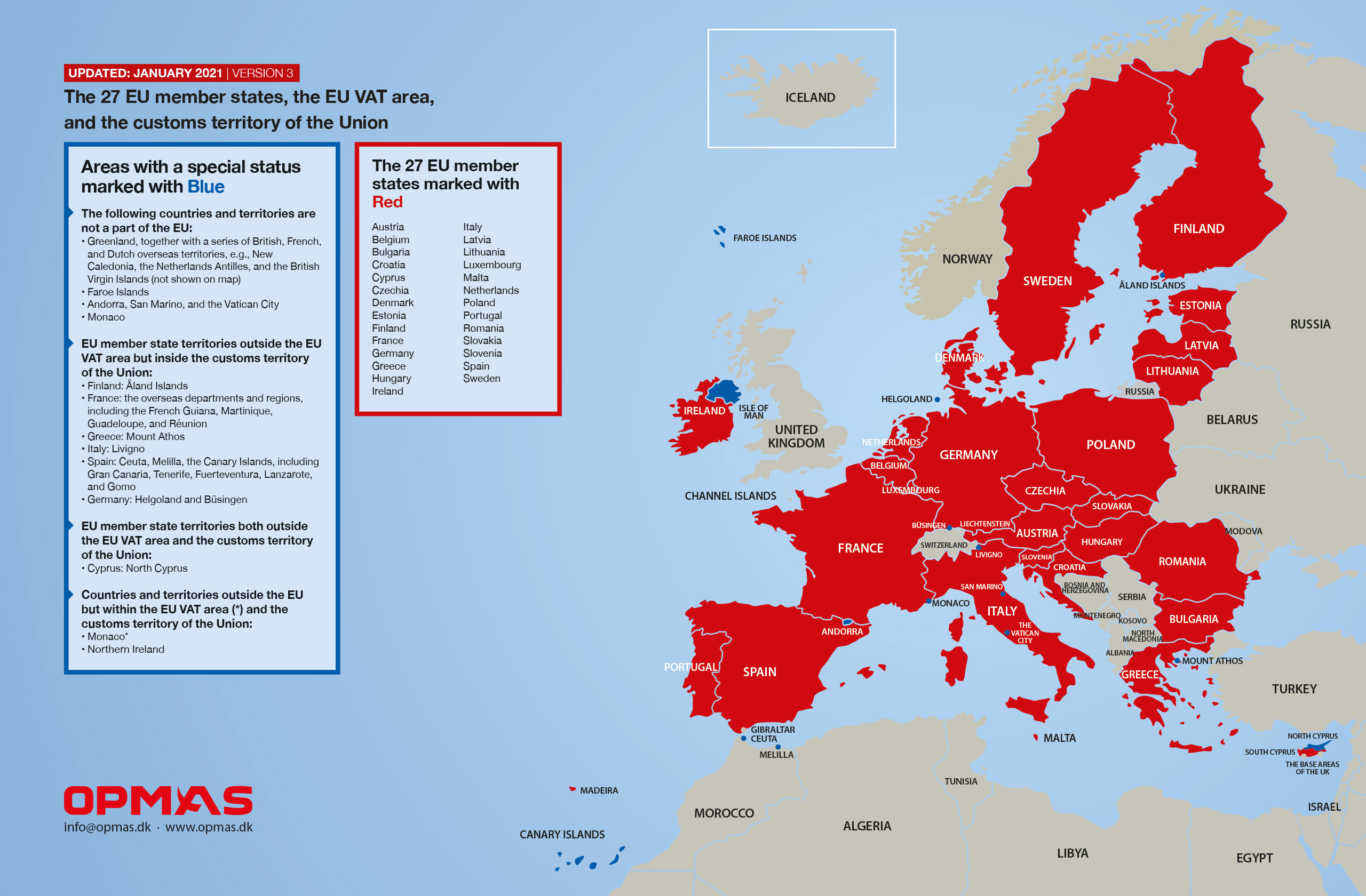
If you are confused about the Schengen area, the EU, and the customs territory of the Union, please consult these maps made for aviation use.
Wrap-up
The year 2025 has again shown that TA is, without any doubt, the preferred option for most international operators. It has proven to be a smooth procedure when everything is checked and prepared in advance. Consequently, we always recommend using TA whenever practically possible.
At OPMAS, we offer tailored TA solutions depending on the risk and travel profile. We have successfully handled thousands of cases over the years without any problems whatsoever, including ramp checks in more demanding jurisdictions, such as France, Italy, Spain, Portugal, and Greece. Feedback tells us that customs inspectors are typically satisfied once operators can present a convincing and well-organized portfolio, demonstrating TA compliance.
If you wish to learn more, please inquire, and we will send you our TA overview.
In the coming months, we look forward to sharing more information and updates on what will happen in 2026. Please stay tuned.
How can we help?
If you have questions about the above, please do not hesitate to contact us.
Follow OPMAS on LinkedIn
Get a continuously stream of news and hints about EU importation and admission issues.
Remember to click Follow on LinkedIn